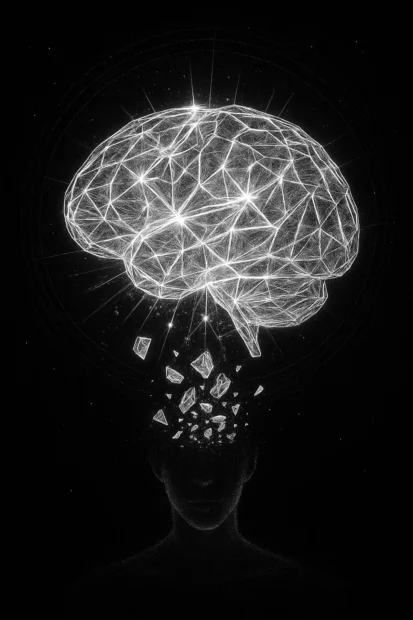
A psychological, systemic and reflexive analysis
1. Introduction — Visible Intelligence, Yet Unrecognized
Some forms of intelligence are not invisible.
They are observable, sometimes even obvious.
And yet, they remain unrecognized.
This phenomenon is not due to a lack of information, but to a mismatch between:
- what is expressed,
- and the frameworks used to interpret it.
This raises a simple question:
Are human systems — both familial and institutional — still capable of recognizing intelligences that operate outside expected formats?
2. Childhood — The Absence of an Accurate Mirror
A child’s development largely depends on the quality of the mirror reflected back to them.
To be seen.
To be understood.
To be recognized in one’s uniqueness.
When this mirror is absent or distorted, a gap emerges.
In certain family environments, particularly where narcissistic dynamics are present, a child may experience:
- a lack of recognition of their abilities,
- minimization of their achievements,
- or an inability from the parent to perceive what exceeds their own frame of reference.
This is not necessarily intentional.
But its impact is structural.
The child then understands a paradox:
What they are is not reflected.
And what is reflected does not correspond to what they are.
3. Development of Abilities — From Adaptation to Unification
Between childhood and adulthood, adaptive mechanisms do not disappear.
They transform.
What initially emerged as a response to an environment perceived as incoherent or unstable gradually becomes a structured cognitive architecture.
This evolution often follows several stages:
Childhood
- strong intuition without validation
- inability to understand the gap
- early adaptations (silence, over-adaptation, or opposition)
Adolescence
- awareness of the gap
- rejection of incoherent frameworks
- need for independence
- development of autonomous thinking
Adulthood (consolidation phase)
- consolidation of developed abilities
- transformation of analysis into a strategic tool
- ability to create, structure and act independently
- gradual detachment from the need for external validation
4. Breaking Point — From Validation to Autonomy
At a certain stage, a shift can occur.
After prolonged non-recognition, some individuals reach a point where:
- external validation is no longer a relevant reference,
- the expectation of recognition is abandoned,
- and action becomes independent of any prior legitimization.
This moment is not impulsive. It is the result of internal stabilization :
the individual no longer seeks recognition in order to act,
they act because they have reached a sufficient level of internal coherence.
This breaking point marks a fundamental transition:
- from a system dependent on external perception
- to a self-referential and internally coherent system
From that point onward:
- production, creation and decision no longer require authorization,
- the expression of potential becomes direct,
- and one’s trajectory develops independently of traditional validation frameworks.
5. Process Overview
The overall development can be understood as a sequence:
adaptation → structuring → unification → rupture → autonomy → action
6. Self-Mirroring
When the external mirror is absent or unstable, the cognitive system tends to reorganize around itself.
This phenomenon can be understood as a form ofself-mirroring :
- development of an internal reference framework
- strengthening of internal coherence
- progressive alignment between perception, analysis and decision
This is not a sudden “increase in power,” but a progressive internal unification, which later enables the breaking point.
7. Cognitive Development — Adaptations Becoming Strengths
In response to this lack of recognition, certain individuals develop specific abilities:
- Hyper-analysis of human behavior
- Advanced cognitive autonomy
- Rapid detection of inconsistencies
- Systemic and multi-layered thinking
- Ability to connect distinct domains
These mechanisms are not anomalies.
They are intelligent responses to an inadequate environment, later consolidated and integrated.
The context does not create intelligence, but it can accelerate and shape its structuring.
What is often perceived as a mismatch is in reality a cognitive evolution structured under constraint.
8. The Mirror Effect — When the Individual Becomes a Revealer
These individuals share a distinctive trait:
They do not merely exist.
They reveal.
Their coherence, lucidity and singularity act as a mirror to their environment.
This mirror highlights:
- inconsistencies,
- limitations,
- discrepancies between discourse and reality.
The reactions observed (rejection, minimization, silence, projection) are therefore not directed at the individual per se.
They are often reactions to what this mirror exposes.
The issue is not always what is shown.
But what it forces others to see.
9. From Micro to Macro — Pattern Reproduction
What occurs within the family environment does not disappear in adulthood.
These dynamics often reappear at the institutional level:
- lack of recognition of atypical profiles,
- difficulty in evaluating out-of-framework approaches,
- silence in response to projects that are nonetheless visible and documented.
In a context where:
- information is publicly available,
- work is documented,
- analytical tools exist,
the absence of reaction can no longer be attributed to a lack of visibility.
It becomes a signal.
Not about the value of the project,
but about the limitations of the system evaluating it.
10. Consequences — A Systemic Loss
These gaps have concrete consequences:
- underutilization of certain intelligences,
- disconnection between individuals and institutions,
- migration toward more receptive environments,
- reproduction of limiting models.
In the long term, this is not only an individual issue.
It is a systemic one.
A system that fails to recognize certain forms of intelligence deprives itself of:
- creativity,
- innovation,
- and its own capacity to evolve.
11. Toward New Frameworks of Interpretation
Recognizing these profiles does not require creating rigid new categories.
It requires instead:
- expanding analytical frameworks,
- moving beyond standardized formats,
- integrating interdisciplinary approaches,
- and accepting that some intelligences do not manifest in conventional ways.
It also requires individual evolution:
The ability to observe without projecting.
To understand without reducing.
To perceive without invalidating.
12. Conclusion — From Recognition to Action
The issue is not only to be recognized.
It is also to act.
Some individuals, after reaching this breaking point, develop a specific capacity:
- to move forward without permission,
- to structure without prior validation,
- to create without waiting to be understood.
This shift toward action is not a rejection of the external world.
It is the logical consequence of a system that has become stable enough to no longer depend on it.
From the search for recognition
to the creation of reality.
And it is often at this point that systems finally begin to adjust.