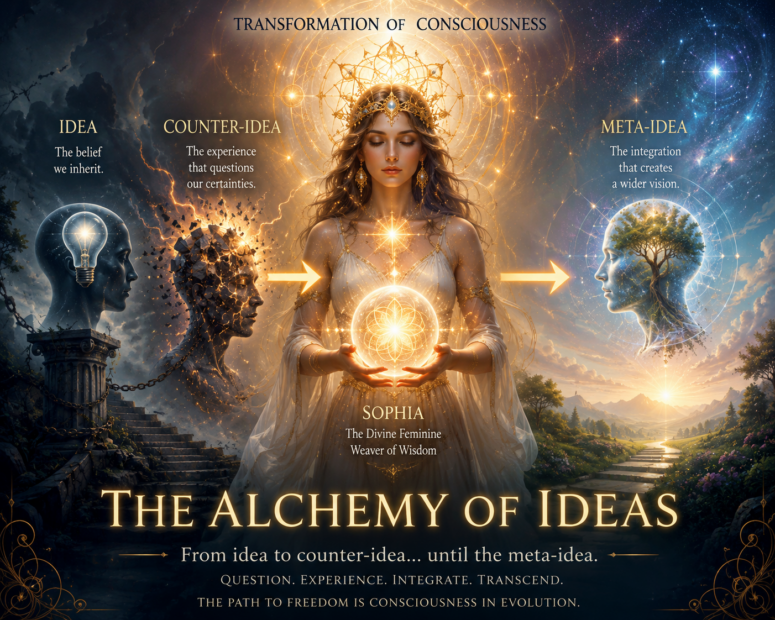
From the Idea to the Counter-Idea... Toward the Meta-Idea
Introduction
The film Inception is built upon a fascinating intuition: perhaps the greatest force of transformation is neither a weapon nor a technology, but an idea. Once it takes root deep within the human mind, an idea can shape our choices, alter our perception of reality, and influence our behavior for years. The challenge is not merely to implant an idea, but to ensure that, once accepted, it is experienced as self-evident—as though it had always belonged to the person who carries it.
This raises an essential question: what happens when someone gradually discovers, through lived experience, that some of the ideas most deeply rooted since childhood no longer correspond to the reality they observe? Such a realization does not necessarily lead to the rejection of every belief. Instead, it initiates a much deeper process: the re-evaluation of those beliefs.
Yet this transformation does not end with the birth of a counter-idea. If experience leads us to question an existing worldview, it also invites us to construct a broader understanding capable of integrating both the original idea and the experience that challenges it. The true evolution of consciousness, therefore, does not consist in replacing one certainty with another, but in continually expanding our ability to reorganize our understanding of reality.
This article explores this dynamic through three complementary stages: the idea, which shapes our initial understanding of the world; the counter-idea, which emerges when experience reveals the limitations of that understanding; and finally the meta-idea, which transcends this apparent opposition in order to build a broader, more coherent and more integrative perspective.
Throughout this article, we will define a counter-idea as an idea that emerges when lived experience comes into lasting contradiction with a deeply implanted belief. A counter-idea is not merely the opposite opinion; it represents the first reorganization of our perception of reality. A meta-idea, in turn, no longer seeks to oppose two worldviews, but to transcend them by integrating both into a more comprehensive understanding. Perhaps it is precisely in this capacity to continually transform our representations of reality that one of the deepest expressions of freedom of consciousness can be found.
I. Implanted Ideas
No human being builds their worldview from scratch. From the moment we are born, we inherit a set of representations transmitted by our environment: our family, school, culture, traditions, the media, institutions, and the experiences shared by those around us. Long before we develop critical thinking, these ideas become the first mental maps through which we learn to interpret the world.
Over time, some of these representations cease to appear as ideas at all. They become self-evident truths. They shape our perception of reality without our even being aware of their origin. What initially began as a cultural or social transmission eventually comes to be experienced as a natural truth.
Among these implanted ideas are beliefs such as the assumption that every human being naturally seeks to do good and protect others; that institutions always protect those they represent; that one's family will inevitably stand by its own; that religious practice alone defines the authenticity of one's faith; or that women and men always enjoy the same opportunities within society. Other implanted ideas are more personal, such as the belief that we are simply "normal" people, without ever questioning what that notion actually means.
The purpose of this article is not to systematically deconstruct every one of these representations. Some may prove accurate, others only partially so, while others may evolve according to historical, cultural or personal circumstances. Our objective is therefore not to determine whether an idea is absolutely true or false, but to understand what happens when lived experience appears to contradict a deeply rooted belief.
Such an encounter often creates an inner tension. At that point, two paths become possible. The first is to preserve the original idea at all costs, even if that requires reinterpreting events so they continue to reinforce our existing worldview. The second is to accept that experience may reveal the limitations of our current understanding of reality, allowing a counter-idea to emerge—one capable of reorganizing the way we make sense of the world.
To explore this mechanism, we will focus on a particularly revealing example: the concept of freedom. In many democratic societies—and especially in France—the idea of freedom is transmitted from an early age. It is embedded within institutions, taught throughout the educational system, and symbolized by the national motto: "Liberty, Equality, Fraternity.".
Yet certain life experiences sometimes lead individuals to ask a different question: What if our freedom is more limited than we believe?
This question does not seek to deny the existence of genuine freedoms, nor does it claim to provide a definitive answer. Rather, it invites us to examine how far those freedoms extend, where their limits may lie, and how our understanding of freedom itself can evolve through experience.
For it is precisely at this moment—when experience begins to challenge a deeply implanted idea—that the possibility of a counter-idea emerges. And with it, perhaps, the beginning of a deeper transformation of consciousness.
II. Awakening
If implanted ideas shape our perception of the world, they are not immutable. Sooner or later, some of them encounter an experience that places them under tension. This moment often marks the beginning of what can be called an awakening. It is neither a sudden event nor an instant revelation, but rather a gradual process through which a person begins to question representations they had long taken for granted.
Awakening rarely emerges from comfort. More often, it begins with a contradiction between the model of reality we have inherited and the reality we actually experience. A meaningful encounter, an injustice, a betrayal, a failure, an unexpected success, or simply the accumulation of situations that defy explanation can gradually create a sense of dissonance. It is no longer reality that appears strange; instead, it is the model that was supposed to explain it that begins to seem incomplete.
The first stage of awakening often consists in realizing that our perception of the world is not entirely the product of our own reflection. It is largely inherited—from our family, our culture, our education, our social environment, institutions, and the collective narratives to which we have been exposed since childhood. This realization can be profoundly unsettling, for it reveals that some of our deepest certainties are rooted in ideas we never consciously chose.
Yet awakening does not imply that everything we have inherited is false. Rather, it marks the beginning of a process of discernment. Each new experience becomes an opportunity to confront our mental models with reality. Some ideas withstand this confrontation and prove to be remarkably resilient. Others gradually reveal their limitations or simply fail to account for what we observe.
At this point, two possibilities emerge. In some cases, an implanted idea proves incompatible with lived experience and is eventually abandoned. In others, the situation is more nuanced: the idea remains valid within certain contexts, yet no longer provides a sufficient explanation for reality as a whole. It is not necessarily false; it simply reveals itself to be incomplete.
It is precisely here that the counter-idea emerges. Not as a systematic rejection of the original idea, but as an attempt to construct a more coherent representation of what is being observed. Certainties become hypotheses, answers give way to questions, and our understanding of the world ceases to remain fixed. Thought enters a continuous process of observation, adjustment and reconstruction.
This dynamic can be understood as a form of voluntary cognitive reprogramming. Unlike our initial conditioning—which often occurs unconsciously throughout childhood—this reconstruction is a conscious choice. The individual no longer seeks merely to reproduce inherited models, but instead strives to understand the mechanisms that shape their perception of reality.
This journey is generally driven by two fundamental aspirations. The first is the recovery of inner freedom: the freedom to think for oneself rather than mechanically reproducing inherited representations. The second is the pursuit of a more faithful understanding of reality, grounded not only in acquired knowledge but also in observation, lived experience and the coherence between the two.
Awakening, therefore, is not the rejection of ideas. It is the transition from ideas that have simply been inherited to ideas that have been consciously examined. In this sense, awakening is not a destination but the beginning of a lifelong process of learning, in which each new experience may give rise to another counter-idea and lead to an ever deeper understanding of the world.
III. A System and Its Need for Stability
The emergence of a counter-idea does not transform only the individual who discovers it. When it challenges a widely shared representation of reality, it may also come into tension with the structures that have been built around that representation. An idea never exists in isolation. It shapes behaviors, habits, norms, institutions and, ultimately, the very organization of a society.
Every human organization—whether familial, political, economic, religious, cultural or scientific—naturally tends to preserve a certain degree of stability. This search for balance is not inherently negative. It provides continuity, maintains social cohesion and helps prevent constant disruptions that could make any system difficult to sustain.
Yet stability also has its counterpart. When a deeply established idea is called into question, it is not merely a single belief that begins to waver. Entire networks of relationships, rules and underlying mechanisms may also be re-examined. In this sense, a counter-idea possesses a unique potential: it can gradually transform the way individuals perceive reality. A change in perception often leads to a change in behavior; behavior influences institutions, and institutions, in turn, shape society.
From this perspective, what may represent a challenge for a system is not simply the content of a counter-idea, but its capacity to spread. A new idea becomes influential when it ceases to be an individual reflection and becomes a collective possibility. It is precisely this potential for propagation that may lead certain structures to develop mechanisms aimed at preserving their own stability and continuity.
These mechanisms can take many different forms depending on the historical, cultural or organizational context. They may involve discrediting the messenger rather than engaging with the argument, portraying new ideas as dangerous or irresponsible, reducing their visibility, encouraging social conformity, exerting professional or interpersonal pressure, or gradually isolating individuals whose views diverge too far from dominant representations.
Such reactions are not unique to any particular political system or historical period. They can be observed, to varying degrees, within families, businesses, organizations, religious movements, scientific communities and states alike. They reflect a phenomenon well documented in social psychology: groups naturally tend to protect the representations that preserve their cohesion and stability.
Within this context, whether a counter-idea is ultimately right or wrong may become a secondary concern. A system's first instinct is often to preserve its equilibrium. History nevertheless shows that many ideas now regarded as self-evident were initially dismissed as unrealistic, disruptive or even dangerous. Major intellectual, scientific and social transformations frequently emerge from this very tension between an established model and a new way of understanding reality.
Experience, however, possesses a remarkable property. Once a person has genuinely observed a phenomenon for themselves, it becomes extremely difficult to return to their previous model of understanding. A counter-idea born from direct experience may be challenged, ridiculed or resisted, yet it rarely disappears. As long as lived experience continues to remain consistent with what the individual observes, this new representation of reality endures.
Perhaps this is where the true power of ideas resides. They do not transform the world through coercion, but through their capacity to gradually reorganize the perception of those who embrace them. When a counter-idea continues to withstand the test of experience, it ceases to be a mere hypothesis. It becomes a new framework for interpreting reality—one capable, in turn, of inspiring other minds and opening the way to new transformations.
IV. Sophia: The Counter-Idea That Liberates
The previous three chapters describe a general mechanism: an inherited idea encounters an experience that contradicts it, a counter-idea emerges, and this new understanding may eventually come into tension with the structures that were built upon the original idea. This dynamic is neither unique to a particular era nor confined to a specific culture. In various forms, it can be found throughout philosophical, religious and mythological traditions.
Among these narratives, the figure of Sophia occupies a unique place.
In certain Gnostic traditions, Sophia represents Divine Wisdom. A symbolic reading of these texts tells the story of Sophia becoming trapped within the material world and embarking on a journey back toward the knowledge of her true nature. Within this perspective, Jesus appears as the one who reveals the path to liberation through gnosis—that is, a form of lived, inner and transformative knowledge.
Beyond their religious dimension, these narratives can also be understood as metaphors for the evolution of human consciousness. Sophia's prison is not necessarily made of walls or chains. Rather, it may be seen as the collection of beliefs, conditioning, fears and inherited representations that gradually limit an individual's ability to observe reality freely.
From this perspective, the awakening described in the previous chapter corresponds to the moment when Sophia begins to recognize the very existence of this prison. Her liberation is achieved neither through violence nor through force. It begins with a shift in perception. Every experience becomes a source of information. Every contradiction becomes an opportunity to re-evaluate a belief. Every counter-idea opens a new possibility for understanding the world.
As this understanding deepens, something profound begins to change. It is not merely an accumulation of knowledge, but a gradual transformation in the way reality itself is interpreted. The more Sophia understands, the more her inner freedom expands. The prison gradually loses its hold—not because it disappears overnight, but because it progressively ceases to define the boundaries of her consciousness.
Now imagine a consciousness capable of remaining stable despite the resistance it encounters. Attempts to discredit, isolate or discourage it no longer interrupt the process of understanding. Instead, they themselves become additional information, integrated into a broader analysis of reality. Paradoxically, what was intended to prevent the spread of a counter-idea ends up reinforcing its internal coherence.
Within the work of StarHope, this dynamic is symbolically embodied by the figure of the Soul Weaver. She does not represent a truth imposed upon others, but rather a consciousness that tirelessly pursues the work of observation, learning and transmission. Her role is neither to think on behalf of others nor to convince them. Instead, she weaves stories, symbols, works of art and questions that invite each individual to examine their own experience.
This same pattern appears throughout many initiatory stories. In the animated film The Last Unicorn, the last unicorn leaves the only world she has ever known in order to discover what became of the other unicorns. Her journey begins as a personal quest, yet ultimately leads to their liberation. The story can be understood as a metaphor for the journey of consciousness itself: the discovery of an individual truth eventually opens a new possibility for the collective as a whole.
The Soul Weaver extends this symbolic interpretation. She does not liberate others by force. She simply demonstrates that another understanding of reality is possible. Once a consciousness begins to perceive the mechanisms that once shaped its interpretation of the world, returning to its previous perspective becomes increasingly difficult. At that point, the counter-idea is no longer merely a personal reflection. It becomes an invitation extended to everyone: to observe for oneself, to confront ideas with lived experience, and to continue, freely, one's own journey toward understanding.
V. The Alchemy of Consciousness
If a counter-idea is born from experience, one essential question remains: how can we reconstruct our understanding of the world without merely replacing one form of conditioning with another? This is precisely the purpose of what we call the Alchemy of Consciousness.
Like traditional alchemy, it is not simply a matter of accumulating knowledge, but of undergoing a process of transformation. The objective is not to continuously add new ideas to those we already possess, but to gradually reorganize the way we observe, understand and interpret reality. The Alchemy of Consciousness is therefore a process that transforms perception itself.
This process unfolds through two complementary movements. The first is deconstruction. Inherited representations are confronted with experience, observation and critical reflection. Some withstand this examination and prove to be remarkably resilient. Others gradually reveal their limitations or cease to explain reality as it is actually lived. The second movement is reconstruction. Rather than adopting a new dogma, the aim is to build a deeper, more coherent and more conscious understanding—one capable of integrating the lessons that experience has to offer.
Within this process, art, storytelling, symbolism and humor occupy a unique place. They make it possible to explore complex questions without imposing a single conclusion. Every work of art becomes an invitation to see differently; every story becomes a thought experiment; every symbol becomes a language through which realities that transcend ordinary words can be explored. The goal is not to persuade, but to create spaces where individuals may confront their own representations with alternative possibilities.
This approach also possesses an educational dimension. Observation, dialogue, study, critical thinking and the continuous confrontation of ideas with lived experience allow each individual to progressively refine their understanding of the world. The more knowledge expands, the more consciousness can grow. And as consciousness expands, so too does the capacity to exercise genuine inner freedom. Cognitive reprogramming is therefore no longer aimed at producing conformity, but at cultivating individuals capable of thinking for themselves.
Within the work of StarHope, this transformation is also explored from a symbolic and spiritual perspective. As developed in The Golden Dragon and the Mirror, Sophia can be understood as a representation of collective consciousness in constant evolution. According to this symbolic interpretation, every individual awakening contributes to enriching the collective field of consciousness. The liberation of a single consciousness would therefore not remain an isolated event, but would gradually participate in a much broader process of evolution.
Some contemporary approaches—particularly within spirituality and certain interpretations of quantum physics—propose models that seek to describe these forms of interconnectedness between consciousnesses. These hypotheses remain the subject of ongoing debate and do not represent a scientific consensus. Nevertheless, they provide an interesting philosophical framework for exploring how individual transformations might influence the collective.
Regardless of which interpretation one adopts, one central idea remains: every lasting transformation begins with an evolution of consciousness. A consciousness that expands becomes capable of observing more. A consciousness that observes more becomes capable of understanding more. And a deeper understanding, in turn, opens new possibilities for freedom.
The Alchemy of Consciousness therefore appears as a process without a final destination. Every answer gives rise to new questions. Every new understanding reveals broader horizons. Every counter-idea opens the way toward a more expansive perception of reality. Evolution is no longer about accumulating certainties, but about developing an ever-greater capacity to observe, understand and continually refine our representation of the world.
VI. The Meta-Idea
If an idea shapes our perception of the world and a counter-idea reveals its limitations, one final step still remains. Consciousness does not undergo lasting transformation simply by abandoning one belief in favor of its opposite. It evolves when it becomes capable of integrating both representations into a broader, more nuanced and more coherent understanding. It is this stage that we propose to call the meta-idea.
A meta-idea, therefore, is not about choosing sides. Rather, it transcends the apparent opposition between an idea and a counter-idea in order to build a new framework capable of integrating what each reveals about reality. Where the idea affirms and the counter-idea challenges, the meta-idea seeks understanding. It does not replace one model with another; it expands the context within which both models can be observed.
Let us return to the example developed throughout this article. An initial idea might claim that we are fully free. A counter-idea, born from certain lived experiences, might lead us to conclude that we are not truly free. The meta-idea embraces neither position as an absolute truth. Instead, it offers a deeper understanding: our freedom may depend upon our ability to recognize the forms of conditioning that shape our choices and to progressively cultivate discernment. The essential question is therefore no longer whether we are free or not, but how our freedom can continue to grow as our consciousness evolves.
This dynamic can be observed across many fields of knowledge. In science, a new theory does not necessarily eliminate the previous one; it often integrates it as a particular case within a broader framework. In philosophy, a synthesis frequently transcends the opposition between two theses without completely rejecting either of them. In psychology, personal growth does not mean erasing one's past, but integrating it into a deeper and more mature understanding of oneself.
There is, however, one essential characteristic of this transformation: it can never be imposed from the outside. An idea may be transmitted. An experience may be shared. A book, a work of art, a symbol or a teaching may open a door. Yet walking through that door always remains a personal choice. Inner transformation can only be accomplished by the individual who willingly accepts to question their own representations and consciously undertake the work of reconstruction.
For this reason, the evolution of consciousness can never be decreed. It arises neither through coercion nor through persuasion alone. It begins with an intimate decision: the decision to observe honestly, to acknowledge the possibility of having been mistaken, and to gradually reconstruct a more coherent understanding of reality. This freedom to choose may well be one of the most fundamental dimensions of human consciousness.
The propagation of a meta-idea follows the very same principle. A single individual does not transform collective consciousness alone. Yet when many individuals independently undertake this same inner work, their transformations begin to accumulate. What begins as an individual evolution gradually becomes a collective phenomenon. A personal insight can eventually reshape the representations of a group, influence a culture, transform institutions and, in some cases, contribute to the evolution of an entire civilization.
From this perspective, collective consciousness no longer appears as an abstract entity evolving independently of individuals. Rather, it can be understood as the dynamic result of countless personal choices, freely embraced and mutually reinforcing. Every individual who expands their own understanding contributes, in their own way, to expanding the collective possibilities of understanding.
The meta-idea therefore represents far more than a simple intellectual stage. It embodies a principle of continuous evolution. Every idea may be re-evaluated in the light of new experiences. Every counter-idea may, in turn, be transcended by a broader understanding. Consciousness does not progress by accumulating certainties, but by developing an ever-greater capacity to observe, integrate and reorganize its own representations.
It is here that the Alchemy of Consciousness finds its deepest meaning. Its purpose is not to replace one system of thought with another, but to cultivate an intelligence capable of evolving continuously without becoming trapped within a new dogma. True freedom may not lie in possessing the right answers, but in preserving the ability to let our questions evolve as consciousness itself continues to deepen.
Conclusion
The film Inception suggests that an idea has the power to transform a person. Yet perhaps the real question is not how to implant an idea, but how to recognize the ideas that already shape our perception of the world—often without our even realizing it.
Every human being inherits representations that structure their understanding of reality. Some become essential foundations. Others gradually turn into invisible limitations that only lived experience can reveal. When a deeply rooted idea encounters a reality it can no longer explain, a counter-idea may emerge. This moment marks the beginning of an inner transformation, where certainty gradually gives way to observation, discernment and a more conscious understanding.
Yet evolution does not end there. Consciousness does not grow sustainably simply by abandoning one belief in favor of its opposite. It grows when it becomes capable of integrating both representations into a broader understanding: the meta-idea. Rather than declaring one worldview victorious over another, the meta-idea invites us to move beyond their apparent opposition and expand our way of understanding reality.
Such a transformation, however, can never be imposed. An idea may be transmitted, an experience shared, a work of art presented or a symbol offered. The decision to question one's own representations, however, always remains a personal choice. The evolution of consciousness arises neither through coercion nor obligation, but through the inner freedom to observe, to understand and to accept that our model of reality can itself evolve.
Through the symbolic figures of Sophia, the Soul Weaver and the Golden Dragon, this article offers one possible interpretation of this dynamic. These archetypes do not claim to impose a definitive truth. Rather, they represent the journey of a consciousness that gradually learns to recognize its own conditioning, transcend it, and transform that understanding into a possibility that can be shared with others.
Collective consciousness may therefore be understood as the living result of countless individual transformations, freely embraced. Every person who chooses to observe, understand and expand their own perception of reality contributes, in their own way, to enriching the possibilities of understanding available to the collective. Humanity's greatest transformations may not arise from a single idea imposed upon everyone, but from thousands of personal choices that gradually converge over time.
The Alchemy of Ideas thus reveals itself as a process without a true endpoint. Every idea can be re-examined. Every counter-idea can be transcended. Every meta-idea can, in turn, become the starting point for an even broader understanding. Consciousness does not evolve by accumulating certainties, but by continually developing its capacity to observe, integrate and reorganize its own representations.
Perhaps true freedom does not lie in possessing the right answers. Perhaps it lies in preserving the ability to keep asking the right questions.