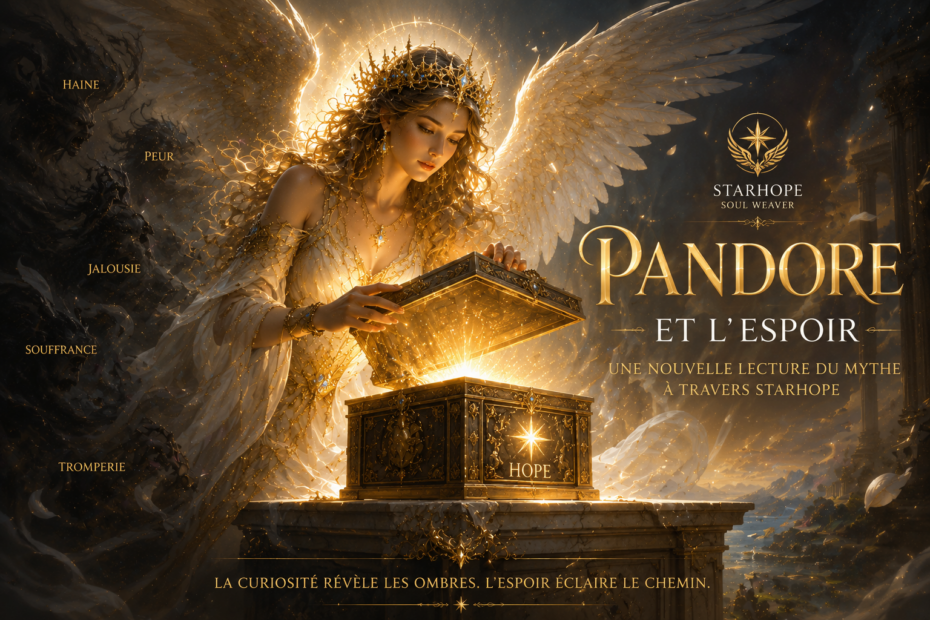
Introduction
The myth of Pandora is one of the most famous stories in Greek mythology. It is often reduced to a simple narrative: Pandora opens a forbidden container, releases all the evils of the world, and humanity suffers the consequences.
However, this interpretation overlooks several important symbolic elements.
When examined more closely, the myth raises questions about curiosity, consciousness, the revelation of hidden problems, and the role of hope in human development. These themes resonate strongly with the philosophy behind StarHope and the symbolic figure of the Soul Weaver.
Pandora and Curiosity
In most versions of the myth, Pandora opens the container because of her curiosity.
Traditionally, this act is presented as a mistake. Yet curiosity is also one of the primary drivers of human progress.
Scientific discoveries, exploration, innovation, and learning all begin with a simple question:
"What happens if we look inside?"
From this perspective, Pandora can be interpreted not as a symbol of recklessness, but as a symbol of humanity's desire to understand reality, even when that reality is uncomfortable.
Without curiosity, there is no doscovery, no evolution, no growth.
Did Pandora Create Evil?
A common interpretation suggests that Pandora brought evil into the world.
However, the myth itself can be viewed differently.
Pandora does not create greed, fear, hatred, jealousy, deception, or suffering.
She releases them.
This distinction is important.
Symbolically, Pandora may represent the process through which hidden problems become visible.
The act of opening the container is less about creating darkness and more about revealing what was previously concealed.
The Mirror Effect
This idea connects with a recurring phenomenon in human psychology and society.
When hidden issues are exposed, people often react defensively.
Individuals, institutions, and entire societies can resist information that challenges their existing beliefs or self-image.
This is sometimes described as a "mirror effect."
The mirror does not create the problem.
It simply reflects it.
In symbolic terms, Pandora's action functions in a similar way. The contents of the container become visible. What was hidden can no longer remain hidden.
The discomfort comes from the revelation, not necessarily from the person who revealed it.
Why Hope Matters
The most significant element of the myth is often overlooked.
After all the other forces escape, one thing remains:
Hope.
This detail completely changes the meaning of the story.
If the myth were only about suffering, it would end with despair.
Instead, it ends with the preservation of a force that allows humanity to continue moving forward despite adversity.
Hope becomes the counterbalance to fear, suffering, and uncertainty.
It is not presented as a denial of reality.
Rather, it is the tool that allows people to face reality without being defeated by it.
The Connection to StarHope
The name StarHope combines two symbolic concepts.
A star represents light, guidance, exploration, and discovery.
Hope represents resilience, possibility, and the capacity to continue despite obstacles.
Together, these concepts reflect a simple idea:
The world improves when people are willing to explore reality while maintaining hope for the future.
This principle applies equally to personal development, scientific research, social progress, and innovation.
The Soul Weaver as a Symbol
Within this framework, the Soul Weaver can be interpreted as an archetype associated with connection and revelation.
The image of weaving suggests the ability to identify relationships between seemingly separate elements.
The image of the mirror suggests the ability to reveal hidden patterns.
Both concepts share a common characteristic:
They make visible what was previously unseen.
Like Pandora, the purpose is not to create problems but to bring awareness to them.
And like the hope preserved within the myth, the ultimate objective is not destruction but transformation.
Conclusion
The myth of Pandora can be interpreted as more than a cautionary tale about curiosity.
It can also be understood as a story about revelation.
Pandora opens what is closed.
She exposes what is hidden.
She forces reality into view.
Yet the final element left behind is not fear or suffering.
It is hope.
For this reason, the myth remains relevant today.
It reminds us that understanding reality and maintaining hope are not opposing forces.
They are complementary.
And together, they form the foundation of meaningful change and humanity evolution.