Introduction
To guide humanity as a whole toward a more just path, it is essential to understand the human dynamics that shape societies.
At StarHope, we consider consciousness to play a role in creating the reality that surrounds us. Thoughts, intentions, behaviours, and individual choices influence human relationships and, by extension, collective structures.
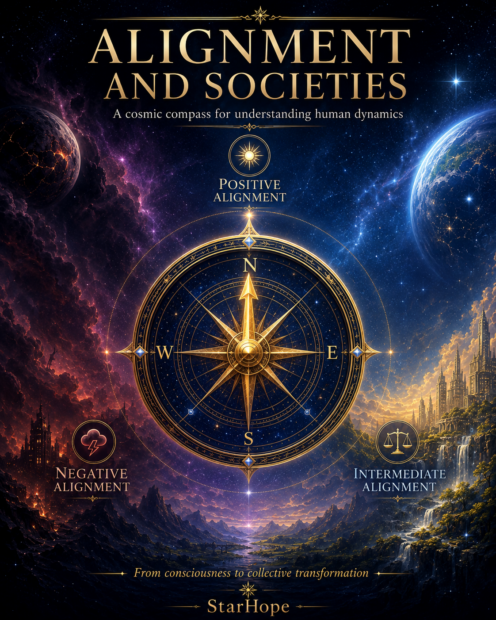
The purpose of this article is therefore to distinguish between individuals within society according to three broad categories, in order to better understand the mechanisms of alignment. Whenever possible, this framework may also help certain individuals realign themselves and thereby contribute to the emergence of a more harmonious society that benefits everyone.
Readers may attempt to identify the alignment in which they currently find themselves, and then freely choose whether or not to evolve according to their own will. This classification is not intended to impose a direction, but rather to provide everyone with a form of guiding compass.
We will therefore distinguish between three broad categories, each of which may be conscious or unconscious of its own position:
- the negatively aligned, whether conscious or unconscious;
- the intermediately non-aligned, whether conscious or unconscious;
- the positively aligned, conscious or unconscious.
These categories describe dominant orientations rather than the entirety of a person, who may display different behaviours depending on the periods and areas of their life.
I. The Negatively Aligned
The negatively aligned include individuals whose behaviours consciously or unconsciously reinforce dynamics of domination, manipulation, exploitation, or destruction within society.
They can be divided into two categories: the consciously negatively aligned and the unconsciously negatively aligned.
1. The Consciously Negatively Aligned
The consciously negatively aligned represent the most dangerous category for society. They deliberately choose to use malicious or illegitimate means in order to obtain or preserve status, power, money, or material advantages.
They may notably resort to:
- manipulation;
- the destruction or neutralisation of their opponents;
- the deliberate organisation of injustices;
- the control of populations or social groups;
- the use of social engineering as an instrument of domination;
- media manipulation;
- the premeditation of crimes;
- the organisation of conspiracies;
- the initiation or perpetuation of conflicts in order to obtain material resources;
- the theft of other people’s wealth, ideas, or work;
- illegal competition or targeted operations intended to eliminate a competitor;
- various forms of abuse orchestrated for personal gain.
In order to deceive those around them or the wider population, these individuals deliberately lie and often seek to present themselves publicly as respectable, virtuous, or well-intentioned people. Their words may therefore stand in radical opposition to their actual actions.
They are not genuinely concerned with the well-being of others. Their priority is to preserve the path they have chosen, along with the advantages, protections, and positions of power they derive from it.
They are generally highly sensitive to exposure. Because their actions must remain hidden, they seek to control information, discredit witnesses, destroy evidence, or carefully conceal the traces of their actions. In the most extreme cases, they may be regarded as criminals operating in the shadows, having consciously sacrificed their empathy and part of their humanity in pursuit of primarily materialistic success.
They rarely question themselves. Because their commitment to negative alignment is conscious, genuine realignment would require them to acknowledge their actions, accept their consequences, and, in some cases, answer for their crimes. This prospect may seem psychologically, socially, or materially unbearable to them. They therefore prefer to continue their strategies of concealment rather than reconsider their choices.
Depending on the context and on circumstances established by facts, this category may include members of criminal networks, malicious occult groups, or political, economic, and institutional structures that consciously use manipulation, violence, war, corruption, or social control for personal purposes.
2. The Unconsciously Negatively Aligned
The unconsciously negatively aligned do not always fully understand the dynamics in which they are participating or the actual consequences of their actions.
They may be manipulated by consciously negatively aligned individuals who know how to use group effects, psychological biases, propaganda, fear, or a sense of belonging in order to turn them into instruments serving their own interests.
These individuals often hold a strongly materialistic worldview. They rarely question themselves and seldom reflect on the collective consequences of their behaviour. Their actions may seem justified to them because they are rooted in deeply ingrained beliefs that they do not seek to examine or overcome.
Among the dynamics that may keep them in this alignment are:
- ego;
- racism;
- misogyny;
- greed;
- adherence to a spiritual or ideological cause used to justify attacks against innocent people;
- taking pleasure in harming someone;
- a sense of power;
- the belief that they are untouchable because they belong to a group perceived as influential;
- hatred toward certain symbolic figures, such as dragons within the metaphorical framework developed by StarHope.
The unconsciously negatively aligned may also defend the consciously negatively aligned because they believe that this alliance benefits them. The wrongdoing being committed does not disturb them enough to make them question their loyalty, especially when they believe they may benefit from the group’s status, power, or resources.
3. A Shared Negative Loop
Despite their differences, both categories share one major characteristic: they generally seek to avoid the consequences of their actions.
This refusal of responsibility prevents them from leaving negative alignment and traps them in a continuous toxic loop. Every new manipulation requires another manipulation to conceal it. Every injustice creates new tensions. Every attempt to preserve power artificially increases the need to control, lie, or neutralise those who threaten the stability of the system.
The negatively aligned may therefore target individuals who are more conscious or more positively aligned, whom they perceive as a threat. They may act out of self-preservation, revenge, or fear of exposure. They also seek to manipulate the intermediate categories in order to maintain their influence and expand their power.
The money, status, and authority they have accumulated then become tools used without empathy to protect their interests, silence opposition, and prolong a system whose consequences they refuse to accept.
II. The Intermediately Non-Aligned
The intermediately non-aligned occupy a more fluid position. They do not remain consistently within a clearly positive or negative dynamic. Depending on the circumstances, they may perform beneficial or harmful actions without seeking to establish any deep coherence between their values, choices, and behaviours.
As with the previous category, it is possible to distinguish between the consciously intermediately non-aligned and the unconsciously intermediately non-aligned..
1. The Consciously Intermediately Non-Aligned
The consciously intermediately non-aligned know that they sometimes act in a just manner and sometimes in a harmful one. Nevertheless, they accept this alternation as a way of navigating life while primarily pursuing their own interests.
Their behaviour is therefore largely based on a form of pragmatic selfishness. They may choose to do good when it provides them with an advantage, improves their image, protects their comfort, or fulfils an emotional need. Conversely, they may accept causing harm, looking away, or allowing an injustice to occur when intervening appears too costly.
When they perform a positive action, they may consider that it compensates for harmful actions committed previously. This form of moral accounting reassures them and allows them to preserve an acceptable image of themselves without deeply questioning the way they live.
They will generally not help someone unless they perceive some personal benefit in doing so. This lack of engagement may take the form of:
- cowardice;
- lack of compassion;
- avoidance;
- indifference;
- refusal to take a stand;
- prioritisation of personal comfort.
They rarely seek to solve problems as a whole. Their objective is more often to take what life can offer them without fully considering the consequences of their choices for others.
Their attention and compassion are often limited to their immediate circle: family, friends, partners, or people for whom they feel directly responsible. The difficulties experienced by individuals outside this circle may seem too distant or insufficiently important to justify their involvement.
They are therefore not necessarily devoid of moral awareness. On the contrary, they may perceive their own contradictions but choose not to examine them too deeply. They deliberately place a blindfold over their eyes so that they can continue living without having to transform their behaviour.
2. The Unconsciously Intermediately Non-Aligned
The unconsciously intermediately non-aligned function in much the same way, but without any genuine inner reflection on the moral nature of their actions.
They too may sometimes do good and sometimes cause harm, pursue their personal interests, avoid problems, or limit their compassion to those closest to them. The essential difference lies in their level of awareness.
They do not truly ask themselves whether their choices are just or unjust. They simply live according to their habits, needs, environment, and the opportunities presented to them, without examining the coherence of their behaviour.
Whereas the consciously intermediately non-aligned deliberately place a blindfold over their eyes, the unconscious are, metaphorically, blind. The former perceive certain contradictions but prefer to avoid them; the latter have not yet identified them.
This absence of moral reflection may make them less emotionally troubled than their conscious counterparts. They do not experience with the same intensity the inner conflict between what they know to be right and the choices they actually make.
They may therefore move through life with greater apparent ease, not because their behaviour is necessarily more just, but because they have not yet developed the level of awareness required to perceive its full implications.
3. An Unstable Position
The intermediately non-aligned do not necessarily constitute a fixed category. Their position may evolve according to their experiences, environment, moments of awareness, and the choices they decide to assume.
They may move closer to positive alignment if they develop greater compassion, responsibility, and coherence. Conversely, their constant pursuit of personal interest, passivity, or refusal to intervene in the face of injustice may gradually draw them closer to negative alignment.
Their main difficulty therefore lies in the absence of a clearly assumed direction. They navigate between several dynamics without genuinely choosing which path they wish to reinforce.
This category thus represents an intermediate zone in which the individual may still evolve in several directions. Awareness then becomes decisive: it may either lead to transformation or be deliberately suppressed in order to preserve existing comfort.
III. The Positively Aligned
The positively aligned include individuals whose actions contribute to improving their environment and, more broadly, the collective. Their way of acting is based on a desire to foster beneficial dynamics, whether they are fully aware of it or simply follow a natural inclination to do good.
As with the previous categories, it is possible to distinguish between the consciously positively aligned and the unconsciously positively aligned.
1. The Consciously Positively Aligned
The consciously positively aligned actively contribute to improving the collective. They act voluntarily and thoughtfully, without negative ulterior motives based, for example, on greed, the pursuit of status, or the accumulation of power.
They understand that improving their environment, supporting others, and spreading more light also benefits them. Their actions therefore form part of a virtuous cycle: by contributing to the common good, they help create a fairer, more harmonious environment that benefits everyone, including themselves.
However, this dynamic may come at a cost. Consciously positively aligned individuals are often targeted when they challenge established interests, expose injustice, or disrupt dominant and controlling structures.
They may notably include:
- whistleblowers;
- journalists committed to seeking the truth;
- non-profit organisations and associations;
- advocates for social justice;
- inspired artists;
- environmentalists;
- as well as people working in professions with a strong social dimension.
Depending on their field of activity, their work may conflict with systems based on control, concealment, exploitation, or the preservation of an imbalance of power.
These individuals often see themselves as being entrusted with a mission. They feel a need to act within a specific field, driven by the personal conviction that they are moving in the right direction and should place their abilities at the service of that path.
Their commitment is therefore not limited to an abstract intention. It is expressed through concrete and sometimes demanding actions intended to help society evolve in a beneficial direction.
2. The Unconsciously Positively Aligned
The unconsciously positively aligned are naturally guided toward benevolent behaviour. They are generally reluctant to harm others deliberately, but they have not necessarily developed any particular reflection on a strategy for action or on their role in transforming society.
Their positive alignment is expressed primarily through their everyday attitude.
They may notably:
- help others spontaneously;
- show compassion;
- support people in difficulty;
- create a more peaceful environment around them;
- act with honesty and respect;
- naturally convey trust, kindness, or light through their relationships.
Even without a clearly defined collective project, these individuals also contribute to improving society. Their way of being influences those around them and helps strengthen positive dynamics in everyday life.
They may also be inspired by consciously positively aligned individuals. By discovering causes, projects, or committed people, they may decide to become more deeply involved in the beneficial transformation of society.
Over the course of their lives, they may discover a mission more clearly aligned with their abilities, interests, and sensitivity. Their natural inclination to do good may then develop into a more conscious, structured, and lasting commitment.
3. A Dynamic of Beneficial Transformation
Both consciously and unconsciously positively aligned individuals contribute to improving the collective, but they do so in different ways.
The former develop a vision, a strategy, and a conscious willingness to act. The latter spread their alignment primarily through their way of being and their everyday behaviour.
Consciously positively aligned individuals may inspire, guide, and structure collective action. Unconsciously positively aligned individuals may reinforce this dynamic by naturally spreading benevolent behaviour and gradually joining more conscious initiatives.
Together, they contribute to the formation of a virtuous cycle in which every beneficial action increases the possibility of further positive actions emerging. Their influence may therefore help create societies that are fairer, more cooperative, and more closely aligned with the common good.
Conclusion
Human beings are evolving beings. An individual’s alignment should therefore not necessarily be regarded as a permanent state. It may change over the course of a lifetime, just as the activities, commitments, and choices through which that alignment is expressed may also evolve.
Life experiences, moments of awareness, personal realisations, encounters, or even a spiritual awakening may lead a person to profoundly transform the way they think and act. This evolution may move in a positive direction, toward greater responsibility, compassion, and coherence, but it may also follow a negative trajectory when an individual progressively chooses selfishness, domination, manipulation, or the refusal to face the consequences of their actions.
The categories presented in this article are therefore not intended to confine human beings permanently within fixed identities. Above all, they provide an informative and reflective framework designed to help each person better understand their own position, the dynamics in which they participate, and the effects their choices produce on their environment.
Every reader remains free to use this compass to move more consciously toward positive alignment, should they wish to do so. Such a transformation cannot be imposed from the outside. It depends on a personal decision, the ability to question oneself, and the willingness to create greater coherence between one’s values, words, and actions.
The purpose of this reflection is therefore individual, collective, and civilisational at the same time. By becoming more aware of the influence of our behaviour, we can better understand how personal choices gradually reinforce certain social dynamics. Every action contributes, on its own scale, either to strengthening systems based on fear, exploitation, and control, or to bringing forth structures that foster cooperation, justice, and the common good.
Might the key to creating a truly abundant society therefore lie in the simultaneous cultivation of both inner and outer wealth? Outer wealth can provide resources, opportunities, and the means to act. Yet without inner wealth—consciousness, compassion, integrity, wisdom, and a sense of responsibility—it risks becoming an instrument of domination or sterile accumulation.
Conversely, when material abundance is accompanied by positive inner alignment, it can be placed at the service of individual fulfilment, the collective, and the construction of a more just civilisation.
This reflection may ultimately be summarised by a passage found in both the Gospel of Matthew and the Gospel of Luke:
“For where your treasure is, there your heart will be also.”
— Matthew 6:21; Luke 12:34
What we choose to regard as our true treasure therefore reveals the direction of our heart—and, gradually, the direction of the society we are helping to build.